
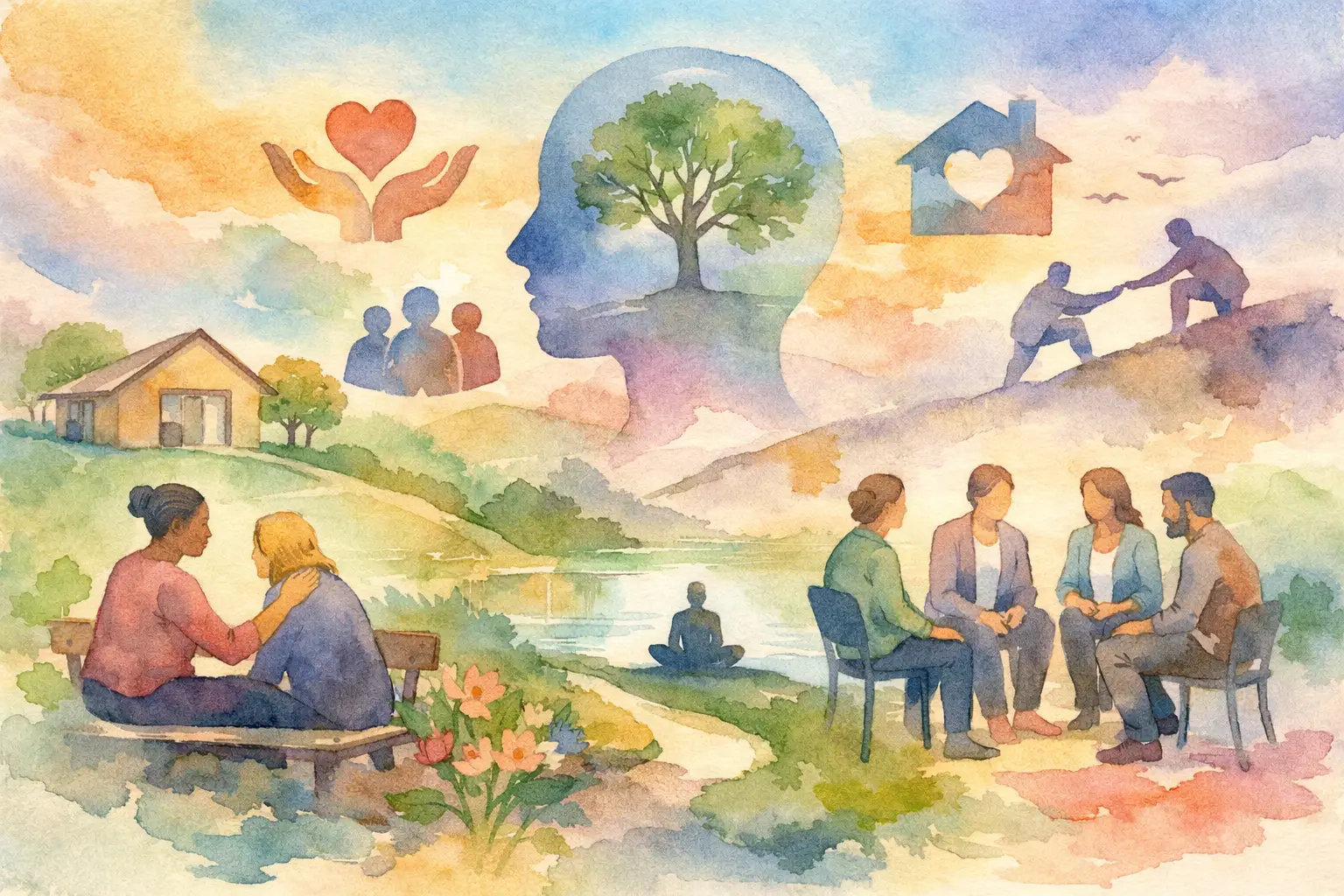
When someone is overwhelmed, burned out, grieving, isolated, or carrying stress that never seems to switch off, the question often is not just where do I go – it is where can I go and still feel safe. That is really the heart of what are community resources for mental health: support that people can access in everyday life, through real relationships, shared spaces, and practical care that does not depend on fitting into a narrow system.
Community resources for mental health are the people, programs, groups, and services that help individuals feel more supported, regulated, connected, and understood. Some are local and face to face. Some are online. Some are formal, while others are rooted in neighborhood networks, schools, faith spaces, charities, peer circles, or community-led wellbeing services. What makes them valuable is not prestige. It is accessibility, trust, and the ability to meet people with humanity.
What are community resources for mental health, really?
A lot of people hear the phrase and assume it only means crisis services or government-funded programs. Those can matter, but community resources are much broader than that. They include any accessible form of emotional support that helps people cope, reconnect, and feel less alone.
That might look like a low-cost community therapy service, a support group for parents, a youth mentoring program, a grief circle, a school wellbeing team, a community center offering emotional skills workshops, or a faith leader trained to respond with care rather than judgment. It can also include online emotional support spaces when travel, location, mobility, or privacy make in-person help harder.
The key idea is simple: support does not have to begin in a clinical room to be real. For many people, especially those who have felt overlooked or unsafe in traditional settings, community-based support is often the first place where healing feels possible.
Why community support matters so much
People rarely struggle in isolation without context. Stress builds in families, workplaces, schools, housing situations, financial pressure, grief, discrimination, caregiving, and disconnection. If emotional pain is shaped by life, it makes sense that support should also exist within life.
That is where community resources can be powerful. They reduce the gap between needing help and actually getting it. They can be lower cost, easier to access, less intimidating, and more culturally responsive than systems that feel distant or hard to enter. They also offer something many people need before anything else: relational safety.
Safety matters because people open up when they feel met without shame, without fear, without being talked down to. A community setting will not automatically feel safe just because it is informal. Some spaces can still feel dismissive or poorly equipped. But when a service is trauma-informed, respectful, and grounded in human connection, it can help people settle enough to begin understanding what they need.
Types of community resources for mental health
The answer to what are community resources for mental health depends partly on the community itself. What is available in one area may not exist in another. Even so, most community support falls into a few recognizable forms.
Community therapy services are one of the clearest examples. These offer low-cost or funded emotional support for people who may not be able to access private care. Good community therapy does more than make support cheaper. It makes it more approachable.
Peer support groups also play an important role. These can help people feel less isolated by connecting them with others who understand parts of what they are carrying. The benefit is often not advice. It is the relief of being with people who do not require a performance.
Schools, colleges, and youth organizations can be major resources too. For children, teenagers, and young adults, emotional support that is available in familiar environments can make a huge difference. A trusted adult, a wellbeing lead, or a safe group space may become the bridge that helps someone ask for more support.
Faith communities, cultural organizations, and grassroots groups can also be essential, especially when mainstream services have felt alienating or inaccessible. These spaces often understand the language, values, family dynamics, or community realities that shape how distress is experienced.
Then there are practical support services that affect mental health even if they are not labeled as therapy. Housing support, food access, parenting support, domestic abuse services, bereavement organizations, and community centers all matter. Emotional wellbeing is deeply connected to whether a person feels safe, resourced, and less alone in daily life.
What good community support should feel like
Not every resource is the right fit for every person. That is not failure. It is simply a reminder that support works best when it matches real needs.
A helpful community resource should feel accessible, respectful, and clear. You should know what kind of support is being offered, who it is for, and how to take the next step. The people involved should communicate in a way that feels calm and human, not cold or shaming.
It should also leave room for choice. Some people want one-to-one support. Others feel safer starting in a group. Some need practical tools first, while others need a place to be heard. Community care is strongest when it does not force everyone into the same model.
A trauma-informed approach matters here. That means paying attention to safety, trust, pacing, and the impact of lived experience. It means support is not something done at people. It is built with them.
What are community resources for mental health if local options are limited?
This is a real issue, especially for people in rural areas, people with limited mobility, carers, or anyone who cannot safely access nearby services. In those cases, online community resources can be deeply valuable.
Online therapy, virtual support groups, digital workshops, and remote training can widen access in meaningful ways. They can also offer privacy for people who are not ready to seek help in visible local spaces. The trade-off is that online support still needs warmth, structure, and emotional safety. Digital access alone is not enough.
That is one reason community-focused organizations that work online can matter so much. They make support available beyond geography while still keeping the human element at the center. AINT Foundation CIC, for example, builds emotional support around safety, regulation, and non-judgment so that help feels more like real support and less like a system people have to brace themselves for.
How to find the right support for you or someone else
Start with the smallest honest question: what feels most needed right now? Not forever. Right now.
If the need is connection, a peer group or community support circle may help. If the need is privacy and steadier guidance, low-cost one-to-one support may be a better place to begin. If someone feels overwhelmed by emotions and does not have words for them yet, practical regulation tools and a calm, shame-free environment may matter more than talking at length.
It also helps to notice what has made support feel hard in the past. Cost, fear of judgment, cultural mismatch, long wait times, location, and past experiences all shape whether a resource is usable. Naming those barriers is not being difficult. It is being realistic.
For families, schools, workplaces, and community leaders, the question shifts slightly. It becomes less about where to send people and more about how to create safer environments around them. Training, emotionally skilled communication, and early-intervention tools can turn everyday settings into places where people feel more supported before things escalate.
Community care is not second best
There is still a quiet myth that community-based support is somehow less serious, less effective, or only for people who cannot access something else. That mindset misses the point.
Community resources are not a backup plan for emotional wellbeing. Very often, they are the most human starting point. They recognize that people need support they can actually reach, in language they can understand, from people who can meet them with dignity.
The best support does not make people feel analyzed from a distance. It helps them feel safer in their own bodies, clearer in their relationships, and less alone in what they are carrying. Sometimes that begins with a therapist. Sometimes it begins with a support group, a community program, a trained mentor, or one safe conversation that changes what feels possible.
If you have been asking what are community resources for mental health, the simplest answer is this: they are the supports that bring care closer to real life. And for many people, that closeness is exactly what makes healing feel possible in the first place.